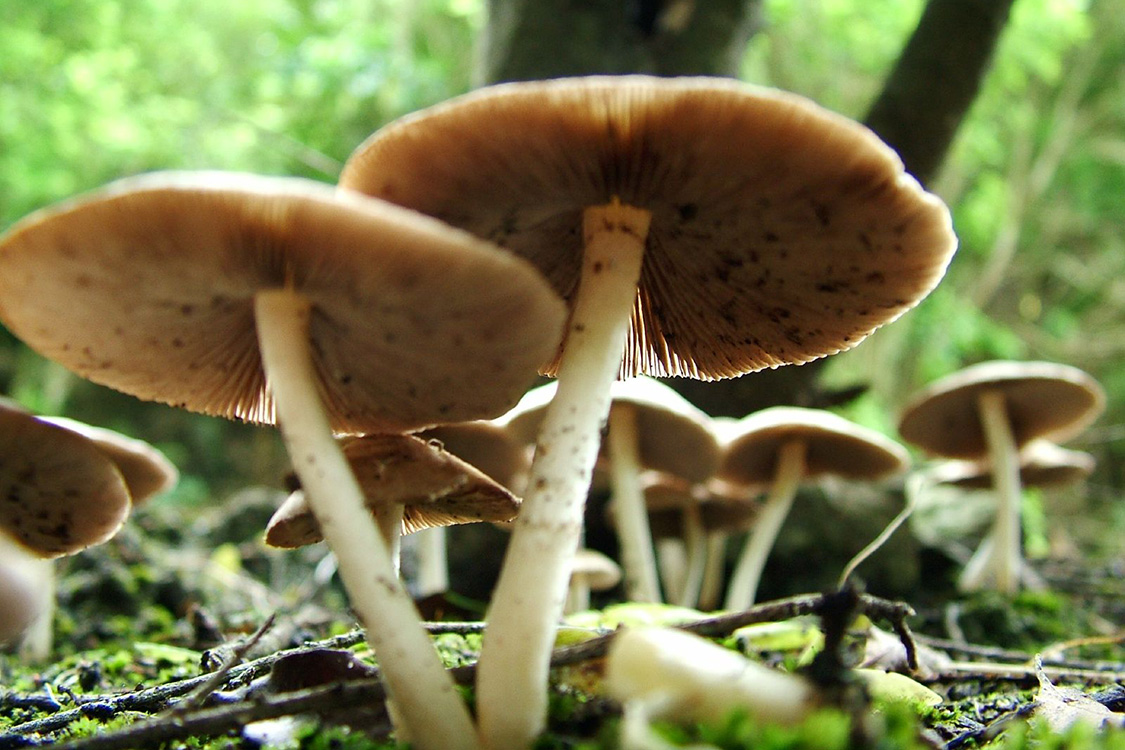
There is a relational field living beneath our feet. And it seems Māori knew about this long before Western science had the instruments to detect it.
I remember attending a two‑day workshop on te ao Māori run by someone from MPI. He spoke about a river and the interconnectedness of the people, the rocks, the water, the plants, the fish — not as metaphor, but as reality. A single living system. A single whakapapa.
When we look at the life of plants through a modern biological lens, this may have been more correct than we ever imagined.
Plant cells contain electrically active structures that behave like neurons. These cells are linked across the entire organism, forming a distributed electrical network. Some biologists describe the whole plant as a kind of brain. And that “brain” doesn’t end at the plant’s surface. It extends into the soil, where the roots connect to other plants through vast fungal networks. Through these networks, plants communicate, share resources, warn each other, and coordinate behaviour.
In 2026, science broadly agrees that plants are astonishingly aware of their environments and each other. They sense. They communicate. They adapt. They remember. They behave as if they have perspectives.
But science still hesitates at the threshold of subjective experience. It says: If plants are conscious, their experience would be alien to us.
A whakapapa‑based epistemology doesn’t stumble here. It doesn’t require plant experience to resemble human experience. It only requires that each being expresses its own form of intelligence, its own mauri, its own mode of participation in the relational field.
Where Western science sees alienness, whakapapa sees continuity. Where science sees incomprehensibility, whakapapa sees relationship.
And even within the human world, awareness is not uniform. Different cultures, different neurotypes, different cosmologies perceive different layers of reality. There’s a story of Bushmen (San people) of the Kalahari Desert wondering why he, Laurens van der Post, couldn’t hear the stars — not as poetry, but as a genuine question. Awareness itself is plural.
If human consciousness can vary so widely, why would plant consciousness — or river consciousness, or forest consciousness — be expected to mirror ours?
Once you accept that intelligence expresses itself through form, not through resemblance to humans, the whole world becomes alive in a new way.
Or perhaps in a very old way.
#bicultural #whakapapa #teaomāori #relationalfield #indigenous
References:
Plant signalling and “neuronal‑like” activity
- Baluska, F., Mancuso, S., & Volkmann, D. (2006). Communication in Plants: Neuronal Aspects of Plant Life. Springer. (Introduces the idea of plant cells exhibiting neuron‑like electrical behaviour.)
- Mancuso, S. & Viola, A. (2015). Brilliant Green: The Surprising History and Science of Plant Intelligence. Island Press. (Accessible overview of plant awareness, signalling, and adaptive behaviour.)
- Trewavas, A. (2014). Plant Behaviour and Intelligence. Oxford University Press. (Argues for plant intelligence as a distributed, adaptive system.)
Mycorrhizal networks (“the wood‑wide web”)
- Simard, S. W. (1997). Net transfer of carbon between tree species with shared mycorrhizal fungi. Nature. (Foundational paper showing resource sharing between trees.)
- Simard, S. W. (2021). Finding the Mother Tree. Knopf. (Popular science account of forest communication networks.)
- Karst, J., Jones, M. D., & Hoeksema, J. D. (2023). The decay of the wood‑wide web? Nature Ecology & Evolution. (A more cautious scientific review.)
Plant awareness, memory, and adaptive behaviour
- Gagliano, M. (2014). Experience teaches plants to learn faster and forget slower in environments where it matters. Oecologia. (Evidence for plant learning and memory.)
- Chamovitz, D. (2012). What a Plant Knows. Scientific American / Farrar, Straus and Giroux. (Clear explanation of plant sensory systems.)
Anthropological reference — hearing the stars
- van der Post, Laurens. (1958). The Lost World of the Kalahari. (He recounts the San people asking why he could not “hear the stars,” which they experienced as a faint high‑pitched ringing.)
- Guenther, Mathias. (1999). Tricksters and Trancers: Bushman Religion and Society. Indiana University Press. (Explores San cosmology and sensory worlds.)
Whakapapa, relationality, and Māori epistemology
- Marsden, Māori. (2003). The Woven Universe: Selected Writings of Rev. Māori Marsden. (Foundational text on whakapapa, mauri, and relational ontology.)
- Royal, Te Ahukaramū Charles. (2007). Te Ao Mārama — A Research Paradigm. (Explains Māori relational epistemology in contemporary terms.)
- Henare, M. (2001). Tapu, Mana, Mauri, Hau, Wairua: A Māori Philosophy of Vitalism and Cosmos. (The metaphysics behind the argument.)









Leave A Comment
You must be logged in to post a comment.