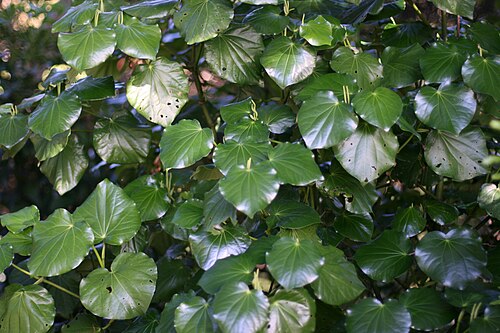
When Māori arrived in Aotearoa, they faced a profound challenge: their familiar pharmacopeia was gone. Coconut, turmeric, ginger, kava, etc. None would grow here. They had to rebuild from the ground up:
• identifying new species
• testing medicinal properties
• determining toxicity
• mapping ecological relationships
Yet Māori weren’t starting from nothing. They carried with them a 5,000‑year Austronesian medical epistemology, coherent, relational, ecological, spiritual.
Western taxonomy asks, “What is this thing?” Māori taxonomy asks, “What is this thing in relation to everything else?” Māori medicine is not “pre‑scientific”; it is another science.
This portable methodology allowed Māori to adapt with remarkable success. And they innovated their educational institutions too: whare wānanga, oral universities that transformed navigational schools into knowledge schools for a new land.
Some ontologies speak of co‑dependent origination — the idea that everything arises in relation. For Māori, this wasn’t abstract philosophy. It was a practical method that made migration successful.
I think about this often in my own work. Stakeholder engagement is also a network of relations, where each interaction must be held with tiaki, aroha, and presence.
I’d love to hear from others working in indigenous knowledge systems: how do you see relational science shaping adaptation and engagement today?
References:
Primary article referenced
Thompson, J., Jordan, F., & Hawkins, J. (2022). Phylogenetic reconstructions of Polynesian medicinal plant use reveal adaptive strategies to meet health needs. bioRxiv. https://www.biorxiv.org/content/10.1101/2022.10.21.513211v1.full.pdf
Māori pharmacopeia and rongoā Māori
Eason, C., McGowan, P. R., Mead, A., Foster, M., Kerridge, D., & Stephens, M. (2025). Giving voice to Ngā Taketake a Tāne: A review of contemporary, traditional and Indigenous pharmacopoeias, and implications for Te Tauihu in Aotearoa–New Zealand. Journal of the Royal Society of New Zealand. (Available via Primo: https://primo.exlibrisgroup.com)
Mark, G., Boulton, A., & Potaka‑Osborne, G. (2025). Rongoā Māori and Western medicine: Advocating for collaborative healthcare in Aotearoa/New Zealand. Journal of Community Systems for Health. (Available via Umeå University: https://www.ub.umu.se)
Ahuriri‑Driscoll, A., & Boulton, A. (2018). Traditional healing and Indigenous wellbeing in Aotearoa/New Zealand. Routledge. https://www.taylorfrancis.com
Austronesian medical epistemology and adaptation
Bellwood, P., Fox, J. J., & Tryon, D. (Eds.) (1995). The Austronesians: Historical and Comparative Perspectives. ANU Press. https://press.anu.edu.au/publications/austronesians
(Already listed above, but included here for completeness) Thompson, J., Jordan, F., & Hawkins, J. (2022). Phylogenetic reconstructions of Polynesian medicinal plant use reveal adaptive strategies to meet health needs. bioRxiv.
Whare wānanga and Māori education systems
Calman, R. (2012). Māori education – mātauranga. In Te Ara – The Encyclopedia of New Zealand. https://teara.govt.nz/en/maori-education-matauranga
Te Whare Wānanga o Awanuiārangi. (2025). Institutional history and mātauranga Māori lecture series. https://www.wananga.ac.nz
Relational taxonomy and ecological science
Harmsworth, G. R., & Awatere, S. (2013). Indigenous Māori knowledge and perspectives of ecosystems. Landcare Research / Manaaki Whenua. https://www.landcareresearch.co.nz
Forster, M. (2022). Amplifying the influence of Māori knowledge in environmental management. Environment and Planning F. https://journals.sagepub.com
Co‑dependent origination and Indigenous epistemologies
Gilbert, S. (2021). Embedding Indigenous epistemologies and ontologies whilst interacting with academic norms. Australian Journal of Indigenous Education. https://www.cambridge.org/core/journals/australian-journal-of-indigenous-education
Arabena, K. (2008). Indigenous epistemology and wellbeing: Universe‑referent citizenship. AIATSIS Discussion Paper 22. https://aiatsis.gov.au





Leave A Comment
You must be logged in to post a comment.